MyBet Casino Notes
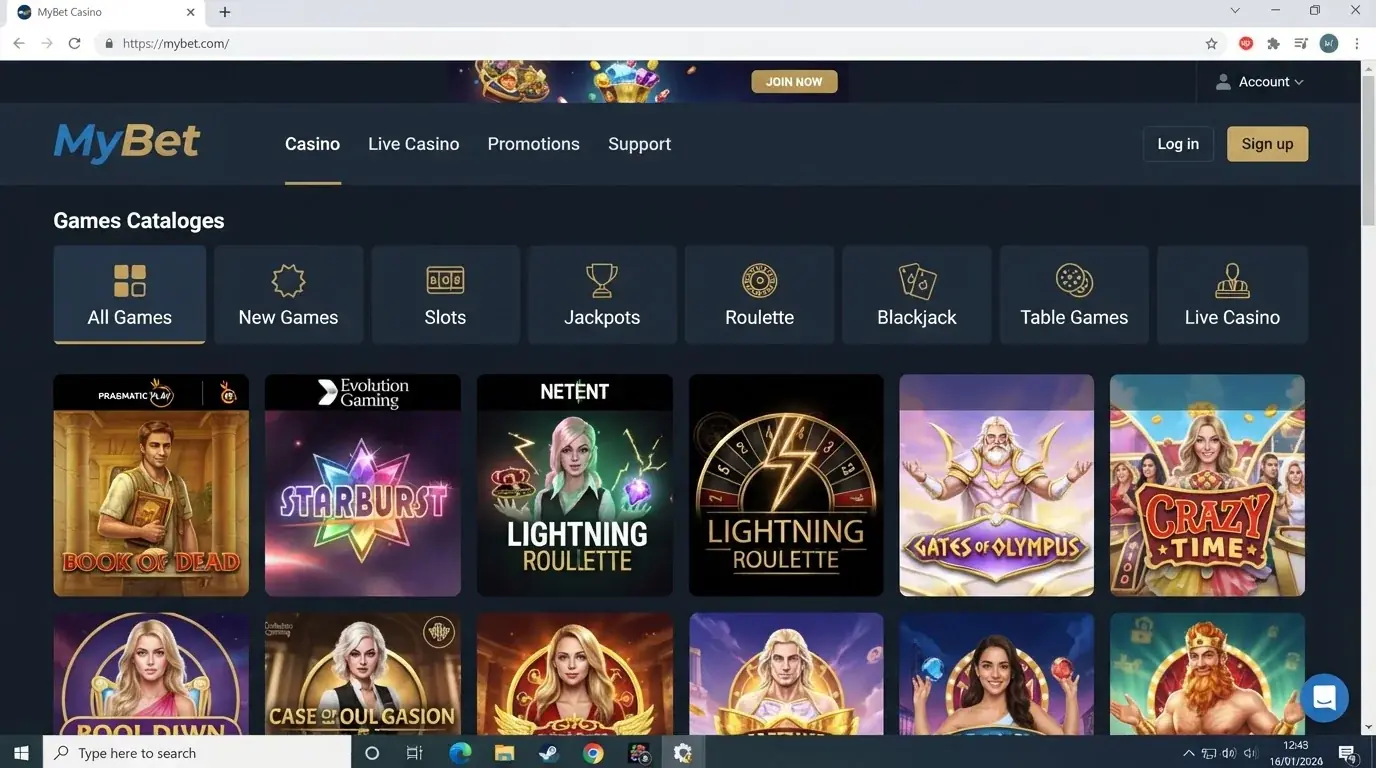
MyBet Casino games and live casino catalogue
 Available in US
MyBet Casino combines digital slots, traditional table games, live-hosted formats and crash titles. The diversity of categories is useful for describing the product, but each game has its own rules, pace and financial exposure. Understanding those differences gives a clearer view than counting icons on a game menu.
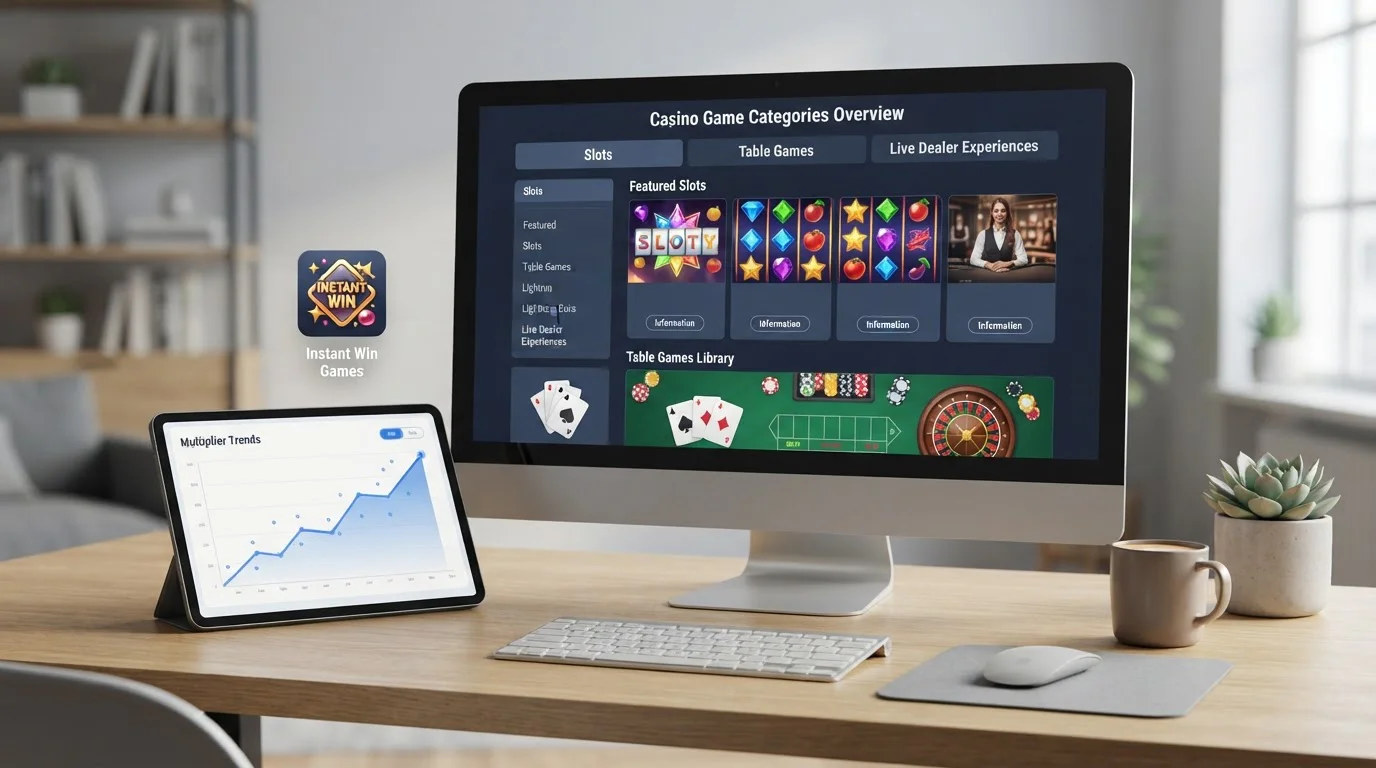
Table of Contents
- Game categories across the MyBet catalogue
- Game suppliers and the depth of the library
- Live tables, bingo and presented game shows
- Crash games and the meaning of provably fair
- RTP, house edge and volatility in context
- Browsing a catalogue on mobile screens
- Questions about the MyBet games catalogue
- What the breadth of MyBet games actually tells you
Game categories across the MyBet catalogue
MyBet Casino brings together reel-based games, classic tables, live-hosted tables and several faster formats. The selection includes slots, roulette, blackjack, video poker, bingo, baccarat, jackpot games, live games, keno, scratch cards, crash titles and live shows. These labels describe quite different ways a result is produced and displayed. A slot normally settles through a mathematical paytable and a random-number generator; a live table involves a dealer or presenter, a video feed and a software interface for placing bets. Bingo, keno and scratch-card formats involve still other structures.
The distinction matters because a large menu does not mean every game carries similar odds or requires similar decisions. A roulette wheel offers fixed bet types with defined payout schedules, whereas a slot combines symbol outcomes, payline or ways-to-win logic and often special features. Video poker uses a draw-and-hold structure that differs from both. A crash title generally presents a rising multiplier and a stopping event, creating a time-sensitive decision before the round ends. The same session budget can therefore be exposed at very different rates as the pace of play changes.
| Catalogue group | Examples associated with MyBet | What shapes the experience |
|---|---|---|
| Slots and jackpots | Video slots and jackpot titles | Reels, paytables, feature rounds, variable prize frequency |
| Digital table games | Roulette, blackjack, baccarat, video poker | Bet rules, card or wheel outcomes, game-specific payout schedules |
| Live dealer and shows | Live roulette, blackjack, baccarat, poker and shows | Video stream, dealer pace, round timing and interface |
| Lottery formats | Bingo, keno, scratch cards | Draw or reveal mechanics and fixed prize structures |
| Fast formats | Crash games | Multiplier movement, early cash-out decisions, rapid rounds |
The table describes the types of game in the MyBet catalogue rather than a promise that every title is present in every account view. Subcategories can overlap: a live show may contain elements of roulette, while a jackpot title is still a slot. It is useful to classify a game by how results occur and what choices the player makes, rather than by its placement in a website menu. The main MyBet overview connects this catalogue with the operator’s broader product mix.
Game suppliers and the depth of the library
Casino Guru lists 41 game providers for MyBet Casino. That figure describes supplier breadth, not the number of individual titles. Provider participation can produce multiple distinct game families, versions and features, and a supplier name alone tells little about the precise rules of a single title. The named suppliers include Novomatic, Pragmatic Play, Betsoft, Evoplay, Habanero, Relax Gaming, PG Soft, 1X2 Gaming, Red Rake Gaming and 3 Oaks Gaming.
These companies are useful navigation markers because their portfolios may emphasise different visual styles and mechanics. Some are familiar for slot libraries, while others also offer live gaming or additional products. It would be misleading to assume that every title from any supplier is included at MyBet. A supplier relationship describes a connection at the catalogue level, whereas a game entry has its own mathematical specification, feature set, interface and sometimes regional distribution conditions.
- Novomatic and Pragmatic Play: recognisable names in digital casino catalogues; a particular game’s rules still have to be read on its own.
- Betsoft and Evoplay: examples of developers whose games may use strongly differentiated presentation and bonus mechanics.
- Habanero, Relax Gaming and PG Soft: names associated with varied slot design and platform distribution.
- 1X2 Gaming: suppliers worth distinguishing by specific title rather than by broad provider label.
- Red Rake Gaming and 3 Oaks Gaming: additional contributors to the supplier inventory listed for the brand.
The supplier count is helpful only when paired with game-level information. Two games carrying different supplier logos can share similar reel structures while having very different volatility. Conversely, a single supplier can publish both straightforward titles and complex games with stacked features. The more reliable comparison is between actual paytables, game rules, bet increments and round tempo. A long provider list is breadth of content; it is not a numerical measure of player protection, payouts or fairness.
For readers comparing the catalogue to how a cryptocurrency wallet is used, MyBet’s payment-method breakdown covers the separate risks involved in transferring digital assets. The cost of a transfer and the expected return of a game belong to different calculations.
Live tables, bingo and presented game shows
The live section of the MyBet profile includes roulette, baccarat, blackjack, bingo, dice, poker and studio-style shows. Live formats typically place a video feed beside a game interface. The feed supplies the presentation and in many products shows a physical dealer or studio equipment; software handles the player’s account-side controls, display and result record. This hybrid format differs from a purely digital table even when the named game is the same.
Round timing is a central practical difference. A software roulette game can often settle soon after the interface receives an input, while a live table may wait for a betting window, a dealer’s actions and a result broadcast. That does not make one format financially safer than another. It changes how quickly play progresses and how many decisions may arise in a given period. A live show can add side bets, special multipliers or staged features, all of which require their own game rules to interpret.
- Read the specific rules: blackjack variants can differ in dealer actions, available doubling options and side-bet conditions.
- Separate the base game from extras: roulette-based shows can add multipliers or special features that change the payout pattern.
- Watch the round structure: a betting window or stream delay affects pace, not the underlying expected value.
- Distinguish video from result settlement: a visual stream is an interface element; the final account result is a separate ledger event.
Live bingo and dice also illustrate why catalogue categories should not be treated as interchangeable. A show with an on-screen host may have a different draw mechanic from a conventional numbered-ball bingo room. The same broad term can cover different rounds and prize structures. For a meaningful comparison, the actual title and rules matter more than whether a game sits under Live Casino, Game Shows or Tables.
Real-time presentation can make a game feel more social or immediate. Neither characteristic changes the fact that outcomes involve financial risk. Session pace, availability of an exit between rounds and the visibility of stakes are practical considerations independent of visual production value.
Crash games and the meaning of provably fair
Crash titles appear in the MyBet Casino game catalogue. In a typical crash mechanic, a multiplier rises from a starting point and a round ends at an uncertain value. A player who exits before that event may receive a multiplier-based return, while waiting past the stopping point may result in losing the stake. The apparent simplicity should not be confused with predictability: previous rounds do not provide a reliable map of when the next round will end.
The term provably fair is sometimes used in descriptions of crypto-oriented games. That phrase describes a method some online games use to let players independently check whether the disclosed inputs produce a recorded outcome. It does not mean that every game offered by a casino uses that method, and it does not guarantee a positive result for a player. For a meaningful verification, the game must provide the exact process and data needed to reproduce an outcome.
Server seed or committed hash
A commitment can bind an operator to information before a round begins; the exact mechanism depends on the game.
Client seed and nonce
Player-side inputs and a round counter may help derive each individual result; implementations vary.
Verification algorithm
The published calculation must reproduce the recorded game result using the relevant inputs.
Game scope
The verifier must be tied to a particular supported game. A general casino label does not validate unrelated slots or live tables.
Consider the difference between verifiable outcome generation and expected return. A hash-based mechanism can help show that a committed outcome was calculated according to specified inputs. It says nothing by itself about whether the payout table is generous, whether a bettor has an edge, or whether a player’s funds can be recovered after a loss. A verification tool is useful only when the game exposes a reproducible sequence, not simply a badge or a marketing phrase.
Crash games can also compress many decisions into a short time. Repeated small stakes and repeated multipliers can make total turnover hard to notice. The right analytical unit is cumulative stake exposure across rounds, not an isolated colourful result on the screen. This is a general property of the format rather than a claimed MyBet payout percentage.
RTP, house edge and volatility in context
Return to player (RTP) is a theoretical, long-run mathematical proportion of stakes returned by a game under its specified rules. House edge is the complementary expected share retained by the game, where that relationship is meaningful. Both concern probability models over extensive play; neither is a promise about one visitor’s outcome. A single session may finish far above or below any long-run theoretical proportion.
Volatility describes how unevenly outcomes may be distributed over time. One game can produce relatively frequent modest wins; another can have a lower frequency of wins but a greater spread of possible payouts. Games with similar theoretical RTP can still feel very different because of that distribution. Jackpot structures and feature-heavy slots make this distinction especially important. A graphic promising a large possible prize describes a possible event, not the probability of obtaining it during a particular session.
A simplified illustration clarifies the arithmetic without attributing percentages to MyBet. If a hypothetical game had a 96% RTP and a player made 100 independent stakes of $1, the theoretical total stake turnover would be $100 and its long-run mathematical expectation of return would be $96, implying a $4 theoretical edge over that volume. These figures describe an invented example for explaining the formula, not a MyBet title, tariff or measured player outcome. Actual short-run results could depart substantially from the illustration.
The number of rounds is a second influence on expected exposure. A faster game can generate more total stake turnover in the same period, even when the nominal stake per action remains low. The relationship is straightforward: total wagering volume equals stake per round multiplied by the number of rounds, while theoretical expected loss equals wagering volume multiplied by a particular game’s house edge. This calculation is meaningful only when the game’s mathematical parameters are identified and the rules are followed.
Different versions of one familiar game can have different payout rules, side bets or optional features. A blackjack side bet, for example, is mathematically distinct from a basic blackjack wager; adding it changes the combination of risks. Comparing an RTP label for one version against a differently configured version creates a misleading impression of precision. A careful game-level comparison starts with the exact variant and rules, then looks at payout schedules and statistical concepts.
Browsing a catalogue on mobile screens
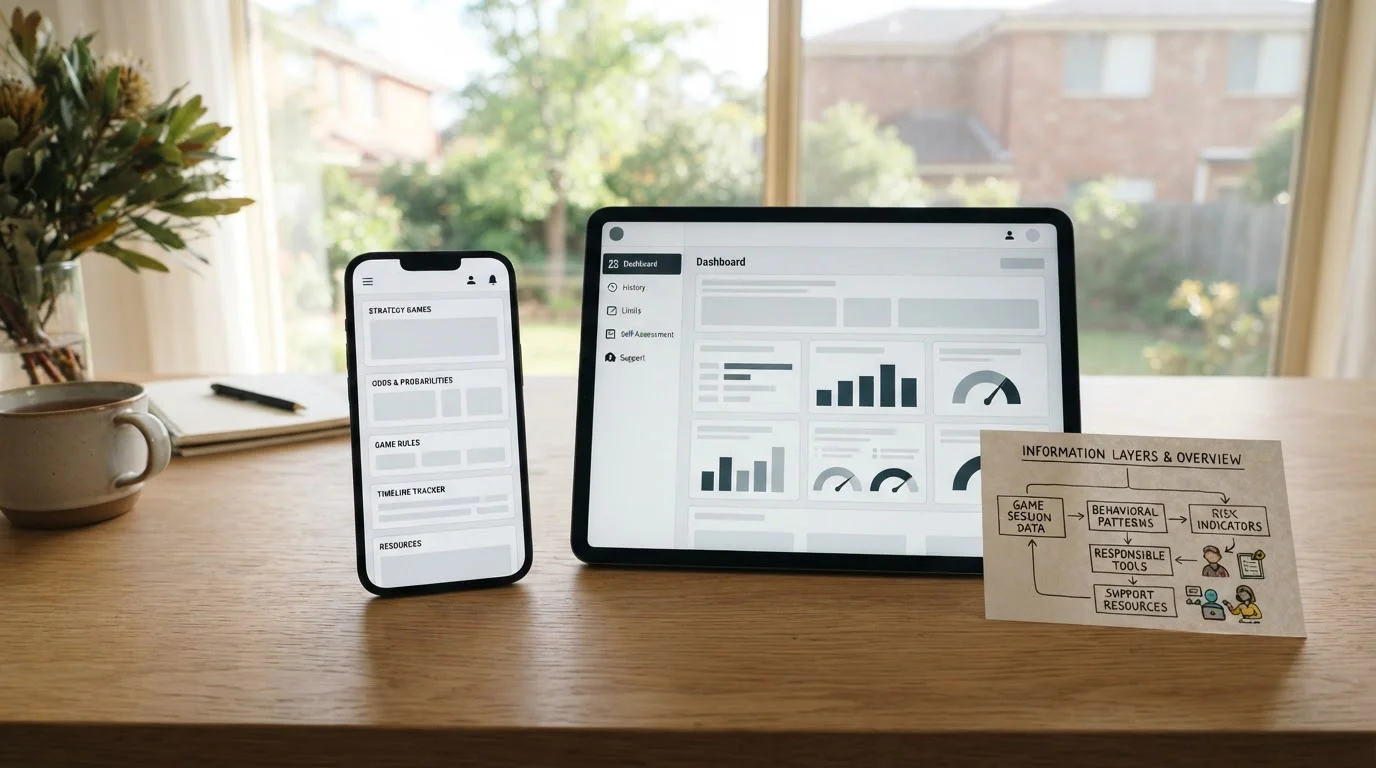
MyBet Casino is represented with a mobile browser interface. A browser-based catalogue can arrange navigation, game previews and stake controls differently on a smaller display. That changes how information is encountered without changing the mathematical mechanics of a game. A game that occupies the full screen may move its rules, paytable or history into secondary menus, making the interface seem simpler than the rules actually are.
The difference between an image of a mobile interface and a native application matters. A mobile screenshot demonstrates that a layout exists in a handheld format; it does not, by itself, identify a dedicated iOS or Android application. The game catalogue should therefore be discussed in terms of viewing and controls rather than assumed app-store distribution or phone-specific features.
Screen dimensions can affect readability of side-bet names, odds tables and timing indicators. In a live game, stream video and betting controls may compete for limited space. In a crash game, the multiplier’s motion may dominate the display while information about round rules remains behind an icon. For a slot, feature symbols and line explanations can be compressed. These are interface-design considerations, not specific defects of a particular MyBet title.
Mobile use is also distinct from transfer technology. A cryptocurrency wallet shown on the same device does not alter the game’s odds or the network requirements of a deposit. Those are separate systems with separate histories and failure modes. Readers who want the underlying distinction between assets, networks and card-to-crypto conversion can find it in the payments analysis.
Questions about the MyBet games catalogue
Which types of games are associated with MyBet Casino?
Its catalogue includes slots, jackpots, roulette, blackjack, baccarat, video poker, bingo, keno, scratch cards, crash games, live dealer tables and live shows.
How many game providers are listed for MyBet Casino?
The MyBet Casino catalogue includes 41 game providers.
Does MyBet Casino include live dealer games?
Yes. The catalogue includes live roulette, blackjack, baccarat, bingo, dice, poker and studio shows.
What does provably fair mean for a game?
It describes a game-specific method for reproducing an outcome from disclosed inputs and a specified verification algorithm. The label does not apply automatically to every casino game.
Does RTP predict the result of a short session?
No. RTP is a long-run mathematical property, while individual sessions can vary substantially.
What the breadth of MyBet games actually tells you
MyBet Casino’s mix of slots, live tables, lottery-style titles, crash games and studio presentations offers more than one model of play. Its 41-provider listing gives a sense of catalogue breadth, while named suppliers help locate distinct styles and mechanics. The important comparison remains game by game: round speed, payout structure, volatility and optional side bets can matter more than the category label.
The provably-fair description should stay tied to individual verifiable games, not extended to the whole catalogue. Likewise, a broad provider roster does not determine a player’s theoretical return or the outcome of any session. This distinction makes the product easier to understand without mistaking variety for a financial advantage. The main overview places the game offering alongside the casino’s payment and service characteristics.
Read next
- MyBet Casino overview
- Crypto payments and transfer risks
- Australian legal status
- Mobile-interface analysis
- Account safety and records
Written by the editors at Mybet.